

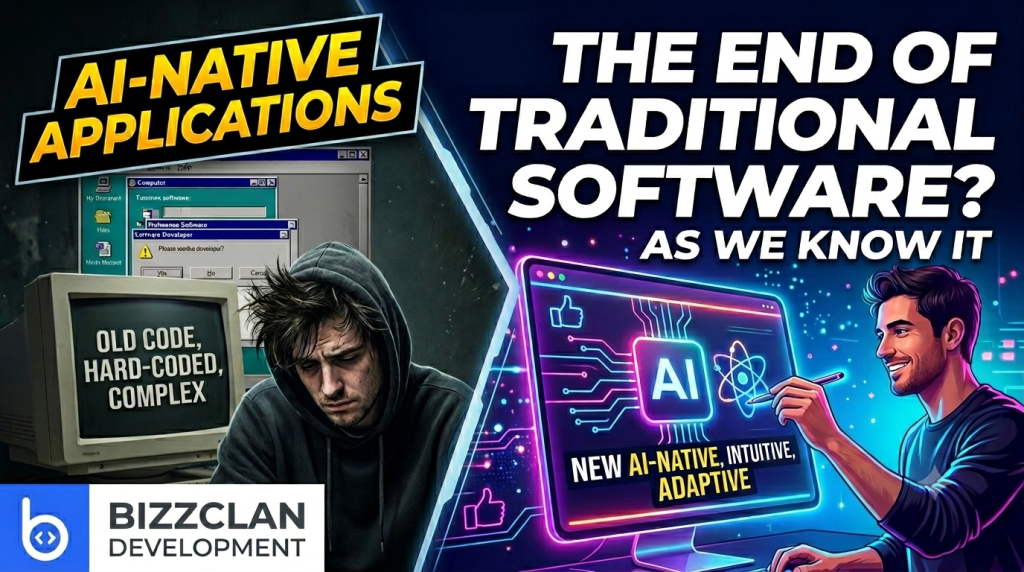
For decades, software has been built around predefined rules, workflows, and user interactions.
Businesses purchased software, configured processes, trained employees, and expected users
to adapt to the system. However, Artificial Intelligence is changing this model entirely.
We are entering the era of AI-Native Applications software products designed with intelligence
at their core rather than AI being added as an afterthought. This shift represents one of the most
significant transformations in the history of software development.
What Makes an Application AI-Native?
Traditional applications rely on fixed workflows. Users click buttons, fill forms, and follow
predefined processes to complete tasks. AI-Native applications operate differently. They
understand context, learn from interactions, automate decision-making, and continuously
improve outcomes.
Instead of simply providing tools, AI-Native systems act as intelligent collaborators capable of
assisting users, generating insights, and performing complex tasks autonomously
Why Businesses Are Moving Toward AI-Native Software
Modern organizations face increasing pressure to improve productivity, reduce costs, and
deliver better customer experiences. Traditional software often creates bottlenecks because
users must manually navigate multiple systems and processes.
AI-Native applications eliminate much of this friction. Employees can interact with systems using
natural language, automate repetitive tasks, and receive intelligent recommendations in real
time.
This shift enables organizations to focus more on strategic work and less on administrative
overhead.
The Rise of Intelligent Business Systems
Across industries, AI-Native applications are transforming operations.
Healthcare providers are using AI-powered platforms to streamline patient engagement and
administrative workflows.
Financial institutions are leveraging intelligent systems for fraud detection, customer service,
and risk assessment.
Software companies are deploying AI copilots to accelerate development, testing, and
deployment processes.
Marketing teams are utilizing AI-driven platforms for audience targeting, content generation, and
campaign optimization.
Beyond Automation
Many organizations mistakenly view AI as simply another automation tool. The reality is far
more significant.
AI-Native applications do not just automate tasks they augment decision-making. These
systems analyze large volumes of data, identify patterns, and provide recommendations that
help organizations make better business decisions.
This capability creates a competitive advantage that traditional software struggles to match.
The Future of Enterprise Software
As AI technology continues to mature, software will increasingly become conversational,
adaptive, and autonomous.
Businesses that embrace AI-Native development today will be better positioned to respond to
changing market conditions, customer expectations, and operational challenges.
The next generation of successful software companies will not be defined by the features they
build, but by the intelligence they embed into every interaction.
Conclusion
AI-Native Applications represent the future of digital transformation. Organizations that continue
relying solely on traditional software risk falling behind competitors that leverage intelligent
systems to drive innovation and efficiency.
The future of software is no longer about creating tools. It is about creating intelligent systems
that think, learn, and evolve alongside the businesses they serve.
