

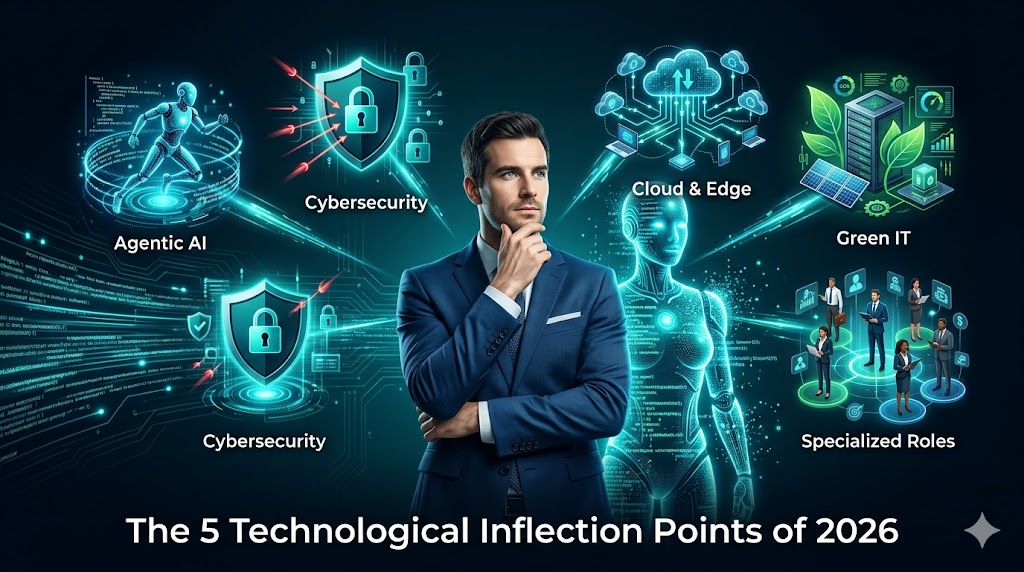
Every decade has its inflection point — the precise moment when the technologies of tomorrow become the requirements of today. We are living through that moment right now. The difference between companies that thrive in the next ten years and those that disappear will come down to how quickly they recognize and respond to five converging technological shifts.
This is not a list of buzzwords. Each of these technologies is already generating billions in investment, reshaping job markets, and rewriting the rules of competition across every major industry. Here is what you need to understand — and what you need to do about it.
1. Agentic AI — The Shift From Tool to Colleague
For years, artificial intelligence has been a tool that waits for instructions. You type a prompt, it responds. You ask a question, it answers. That era is ending. Agentic AI — systems that can set their own objectives, make autonomous decisions, and execute complex multi-step tasks without continuous human supervision — represents the most significant shift in how businesses operate since the internet itself.
Unlike traditional AI systems confined to pattern recognition, AI agents understand context, adapt their strategies as situations evolve, and coordinate multiple resources to achieve a goal. An AI agent does not just answer your question about a marketing campaign — it researches competitors, drafts the copy, schedules the posts, monitors performance, and adjusts the strategy, all without being asked.
“An AI agent does not wait to be asked. It identifies the opportunity, sets the goal, and gets to work. This changes everything about how organizations are structured.”
Where are we today? Research shows 30% of organizations are exploring agentic options, 38% are running pilots — but only 11% have deployed these systems in production. The opportunity gap is massive. Organizations that move from pilot to production in the next 12 months will hold a structural advantage that will be extremely difficult for slower competitors to overcome.
2. Cybersecurity — The Most Valuable Skill on Earth
AI has made cyberattacks cheaper, faster, and more sophisticated — while simultaneously making many traditional defenses obsolete. Threat actors now use AI to generate convincing phishing attacks at industrial scale, to probe networks for vulnerabilities in real time, and to launch coordinated campaigns that adapt to countermeasures as they deploy.
The demand for cybersecurity professionals has reached a point where qualified experts command salaries that rival surgeons and lawyers. According to Robert Half’s 2026 Salary Guide, companies are actively competing to pay premium rates for cybersecurity skills — and still cannot fill their open roles. This is not a temporary shortage. It is a structural deficit that will persist for the foreseeable future.
STAT: Cybersecurity analyst roles projected to grow 367% by 2035 — highest of any tech role
3. Cloud and Edge Computing — Speed Is the New Moat
The question is no longer whether your business should be in the cloud. That debate ended years ago. The question now is how intelligently you are using cloud and edge infrastructure to outmaneuver your competition. Edge computing moves data processing closer to the source — eliminating the latency that kills real-time applications and enabling capabilities that centralized cloud infrastructure simply cannot match.
Autonomous vehicles, smart manufacturing, real-time fraud detection, remote surgical assistance — none of these work with the delay introduced by round-trips to distant data centers. For businesses in logistics, healthcare, manufacturing, and retail, this is not a future consideration. It is a competitive necessity today.
4. Green IT — Sustainability Is Now a Balance Sheet Issue
According to IDC’s FutureScape predictions, 60% of enterprises will implement Sustainable AI Frameworks by 2026 — using data-driven decisions to meet decarbonization goals while scaling AI operations. This is no longer about corporate responsibility optics. It is about regulatory compliance, investor expectations, and operational cost reduction.
Data centers now consume more electricity than many small nations. Organizations that design energy efficiency into their AI and cloud infrastructure from the start will have lower operating costs, stronger regulatory positioning, and better access to ESG-focused capital.
5. Specialized Roles — The Generalist Is Becoming Extinct
The era of the catch-all ‘software engineer’ or ‘data scientist’ title is ending. In 2026, the job market is fragmenting into highly specialized, task-specific roles at the intersection of AI, domain expertise, and business impact. Companies are not hiring people who can do everything moderately well. They are hunting for people who can do one specific, high-value thing exceptionally well.
“The most valuable professionals of 2026 are not the best coders. They are the people who sit at the intersection of deep technical skill and genuine business domain understanding.”
