

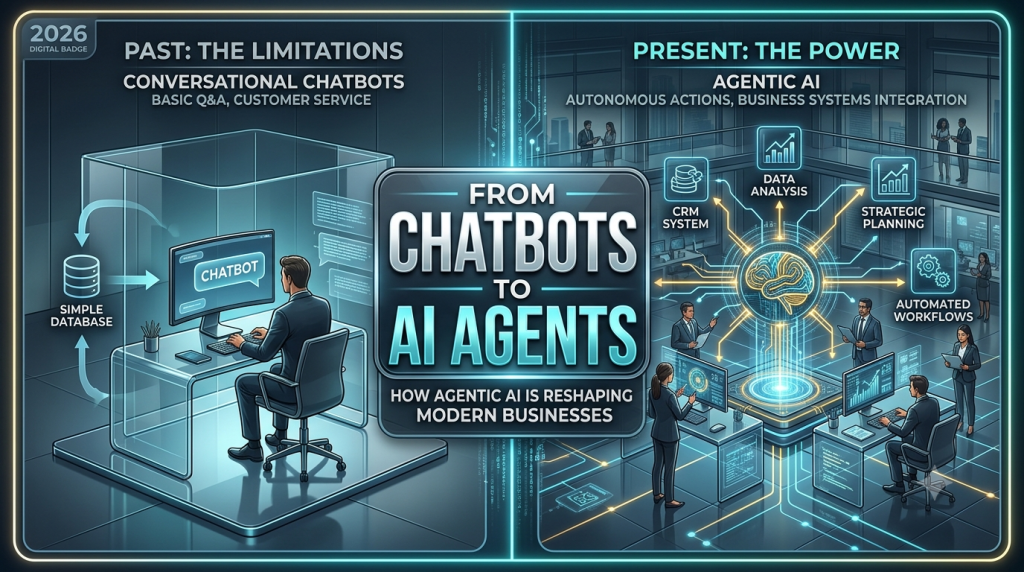
For years, chatbots have been the most visible form of Artificial Intelligence in business. They answered simple questions, handled basic customer requests, and automated routine interactions.
Today, a new generation of AI systems is emerging. Known as Agentic AI, these systems go far beyond answering questions. They can plan, reason, make decisions, and execute complex tasks with minimal human intervention.
Many industry experts believe Agentic AI will become one of the most transformative technologies of the next decade.
What Is Agentic AI?
Traditional chatbots operate reactively. They respond when a user asks a question. Agentic AI operates proactively. It can understand objectives, create action plans, use tools, access information, and complete multi-step tasks autonomously. Instead of simply providing information, AI agents can perform work.
The Evolution from Assistance to Action
The difference between chatbots and AI agents is similar to the difference between a search
engine and a personal assistant.
A chatbot might explain how to schedule a meeting.
An AI agent can identify available times, send invitations, update calendars, and notify
participants automatically.
This shift from assistance to execution is redefining how organizations think about productivity.
Enterprise Applications of AI Agents
Businesses are already exploring AI agents across multiple functions.
Customer support teams use agents to resolve inquiries, update records, and escalate issues
when necessary.
Sales organizations deploy agents to qualify leads, schedule meetings, and generate
personalized outreach.
Human resources departments leverage AI agents for onboarding, policy assistance, and
employee support.
Software development teams use agents for code generation, testing, documentation, and
quality assurance.
Business Benefits
Agentic AI offers several advantages, including increased efficiency, reduced operational costs,
faster decision-making, and improved scalability.
Organizations can automate complex workflows while allowing employees to focus on
higher-value activities.
This creates opportunities for significant productivity gains across departments.
Challenges and Governance
Despite its potential, Agentic AI introduces new challenges.
Organizations must address data privacy, security, compliance, accountability, and human
oversight.
Businesses that implement strong governance frameworks will be better positioned to realize
the benefits of autonomous AI while minimizing associated risks.
The Future of Work
Agentic AI is not designed to replace human expertise. Instead, it is reshaping how work is
performed.
Employees will increasingly collaborate with intelligent systems capable of handling routine
tasks, analyzing information, and executing workflows.
Organizations that embrace this transformation early will gain a substantial competitive
advantage in an increasingly AI-driven economy.
Conclusion
The evolution from chatbots to AI agents represents a major milestone in the development of
Artificial Intelligence.
As Agentic AI continues to mature, businesses will move beyond simple automation toward
intelligent systems capable of executing meaningful work. The organizations that successfully
integrate AI agents into their operations today will help define the future of business tomorrow.
