

As Artificial Intelligence becomes a core part of enterprise strategy, organizations face an
important decision: how can they make AI systems more accurate, reliable, and useful for
business operations?
Two approaches dominate the conversation Retrieval-Augmented Generation (RAG) and
Fine-Tuning. While both enhance Large Language Models, they solve different problems and
deliver different outcomes.
Understanding the difference is critical for organizations planning to scale AI adoption in 2026
and beyond.
The Challenge with Enterprise AI
Large Language Models are powerful, but they have limitations. Most models are trained on
historical datasets and cannot automatically access an organization’s latest information.
This creates a significant challenge for businesses that rely on constantly changing data,
policies, documentation, and operational procedures.
When AI lacks access to current information, the risk of inaccurate responses increases.
What Is Retrieval-Augmented Generation (RAG)?
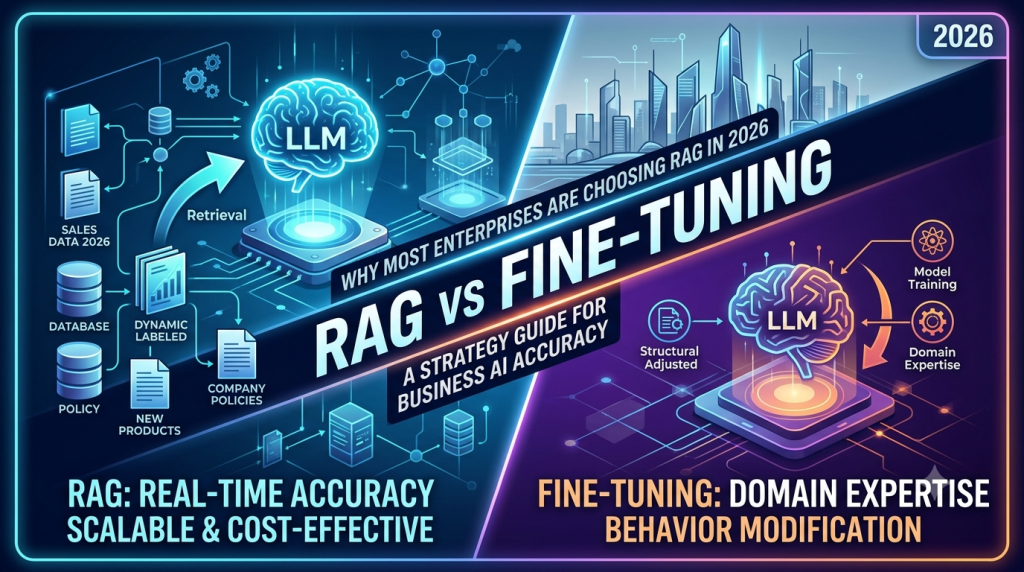
RAG allows AI systems to retrieve information from external knowledge sources before
generating responses.
Instead of relying solely on pre-trained knowledge, the model searches company documents,
databases, policies, and knowledge repositories to gather relevant information.
The result is more accurate, context-aware, and trustworthy responses.
Organizations can update their knowledge base without retraining the model, making RAG
highly scalable and cost-effective.
What Is Fine-Tuning?
Fine-tuning involves training an existing AI model on specialized datasets to improve its
understanding of a particular domain, communication style, or task.
For example, a healthcare organization may fine-tune a model using medical terminology, while
a legal firm may train a model on legal documentation.
Fine-tuning changes how the model behaves, but it does not automatically provide access to
new information.
Why Enterprises Prefer RAG
The primary reason organizations are adopting RAG is flexibility.
Business knowledge changes frequently. Policies evolve. Products launch. Regulations change.
Customer information updates daily.
With RAG, organizations can keep AI systems aligned with current business information without
costly retraining cycles.
Additionally, RAG improves transparency by allowing organizations to trace responses back to
source documents.
The Future Is Hybrid
While RAG has become the preferred approach for enterprise knowledge management, many organizations are combining it with fine-tuning. Fine-tuning can improve behavior and domain expertise, while RAG provides access to real-time information. Together, these approaches create AI systems that are both intelligent and trustworthy.
Conclusion
The debate between RAG and Fine-Tuning is not about choosing a winner. It is about
understanding which approach best aligns with business goals.
For organizations seeking scalable, secure, and continuously updated AI solutions, RAG has
emerged as the foundation of modern enterprise AI architecture. As AI adoption accelerates,
businesses that implement the right strategy today will gain a significant competitive advantage
tomorrow.
