

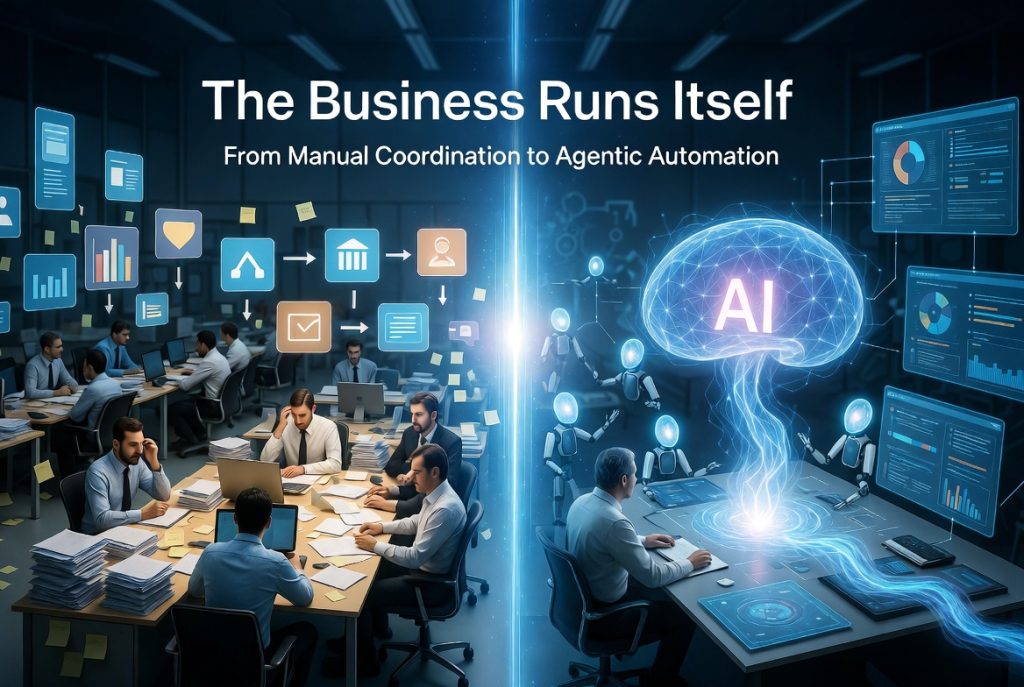
Something has changed in how successful businesses operate, and it is not what most people are talking about. The companies pulling ahead right now are not the ones with the most staff or the longest hours. They are the ones where the business itself does most of the work.
That sounds like a vague thing to say, so let me make it concrete. According to UiPath’s 2026 AI and Agentic Automation Report, 78% of executives say their current operating model cannot keep pace with where the market is going. The businesses that have already rebuilt their operations around connected, intelligent systems are reporting 40 to 60 percent efficiency gains over competitors still running on scattered tools and manual coordination (Redwood Software, 2026). That is not a marginal edge. That is a different category of business.
How Most Businesses Actually Run
For most organizations, growth created complexity. More customers meant more people, more meetings, more tools to manage, more room for things to fall through the cracks. Revenue went up but so did the headache of running the business.
The common response was to add software. A CRM for the sales team. A marketing platform. A dashboard for leadership. On paper this looked like progress. In practice, none of these tools talked to each other. Each one needed someone to maintain it, update it, and manually move data in and out of it. Instead of reducing coordination work, the tools added a new layer of it.
Redwood Software’s 2026 research put it plainly: when AI is added as a separate layer on top of disconnected systems, its impact is limited. The gains only become real when the whole operation — data, decisions, actions — runs as one connected system.
What the Winning Companies Have Done Differently
The businesses consistently outperforming right now made one change that sounds simple but is hard to execute: they stopped using a collection of separate tools and built one system that runs the business.
PwC’s 2026 AI Business Predictions described this as building AI studios — centralized systems where business goals connect directly to execution across every department. In practice, this means a new lead is automatically qualified, scored, and routed without anyone touching it. Sales data updates operations and finance in real time without a weekly sync call. Customer behaviour triggers follow-ups without a team member scheduling them. Leadership sees what is happening across the business right now, not in a report that is three days old by the time anyone reads it.
Agentic AI — The Part Most Businesses Have Missed
The biggest shift happening in 2026 is the move from AI that tells you things to AI that does things. IBM’s 2026 technology outlook describes this as AI moving from answering questions to influencing outcomes directly. These systems — what researchers are calling agentic AI — do not wait for a human to review a recommendation and decide what to do next. They act, based on conditions that have been defined in advance.
Gartner projects that by 2027, this kind of AI will disrupt $58 billion worth of mainstream productivity software. The businesses investing in this infrastructure now are not preparing for the future. They are creating the gap that will define their industry position for the next several years.
How to Know If Your Business Has This Problem
Three questions worth asking honestly. Does the business feel busy without feeling efficient? Is it growing, but internal operations are struggling to keep up with that growth? Does it look modern from the outside but still run on manual processes, human memory, and coordination calls that exist because no system holds the information?
If any of those land, the issue is not the team. The team is probably working hard. The issue is that the architecture underneath the business was not built for this environment. SS&C Blue Prism’s 2026 research confirmed that isolated automation — fixing one task here, one process there — produces gains that fade quickly. What lasts is connecting the whole operation so that it runs without constant human intervention to hold it together.
Where to Start
This does not mean rebuilding everything from scratch. The most effective starting point is identifying two or three workflows where disconnection is creating the most friction, and replacing that friction with a connected system. Every company that has made this shift successfully started small and expanded deliberately — not by trying to automate everything at once.
The goal is simple, even if the execution takes work: insight, decision, and action should happen in one continuous flow, not in three separate systems that require a person in the middle to make them talk to each other.
What BizzClan Builds
We design operational systems that replace the manual coordination businesses depend on — the kind that works fine at a small scale but breaks down as the business grows. The result is a business that runs cleaner, gives leadership better information, and scales without creating a new set of problems at every stage.
The market in the years ahead will not reward effort alone. It will reward the businesses that built the right systems early enough to matter.
